COSHH assessment template
- What a year of COSHH work costs
- 592
- Computed on this page from the inputs below
- Substances in the inventory
- 33
- Computed on this page from the inputs below
- Hours to assess the whole inventory once
- 26.8
- Computed on this page from the inputs below
- What that first pass costs
- 910
- Computed on this page from the inputs below
Every figure the worksheets return is worked from the figures you enter. Where this site names a legal duty or a definition it comes from a public document, cited under the tool it appears in, and nothing here is legal advice about your own workplace.
Email me this result
We will send you these figures and a link back to them. One email, nothing else unless you tick the box.
The figures above start from a worked example (592). Change any input and the answer updates as you type, the way it will the month a new process or a new substance arrives.
Download the COSHH assessment template worked example (CSV)
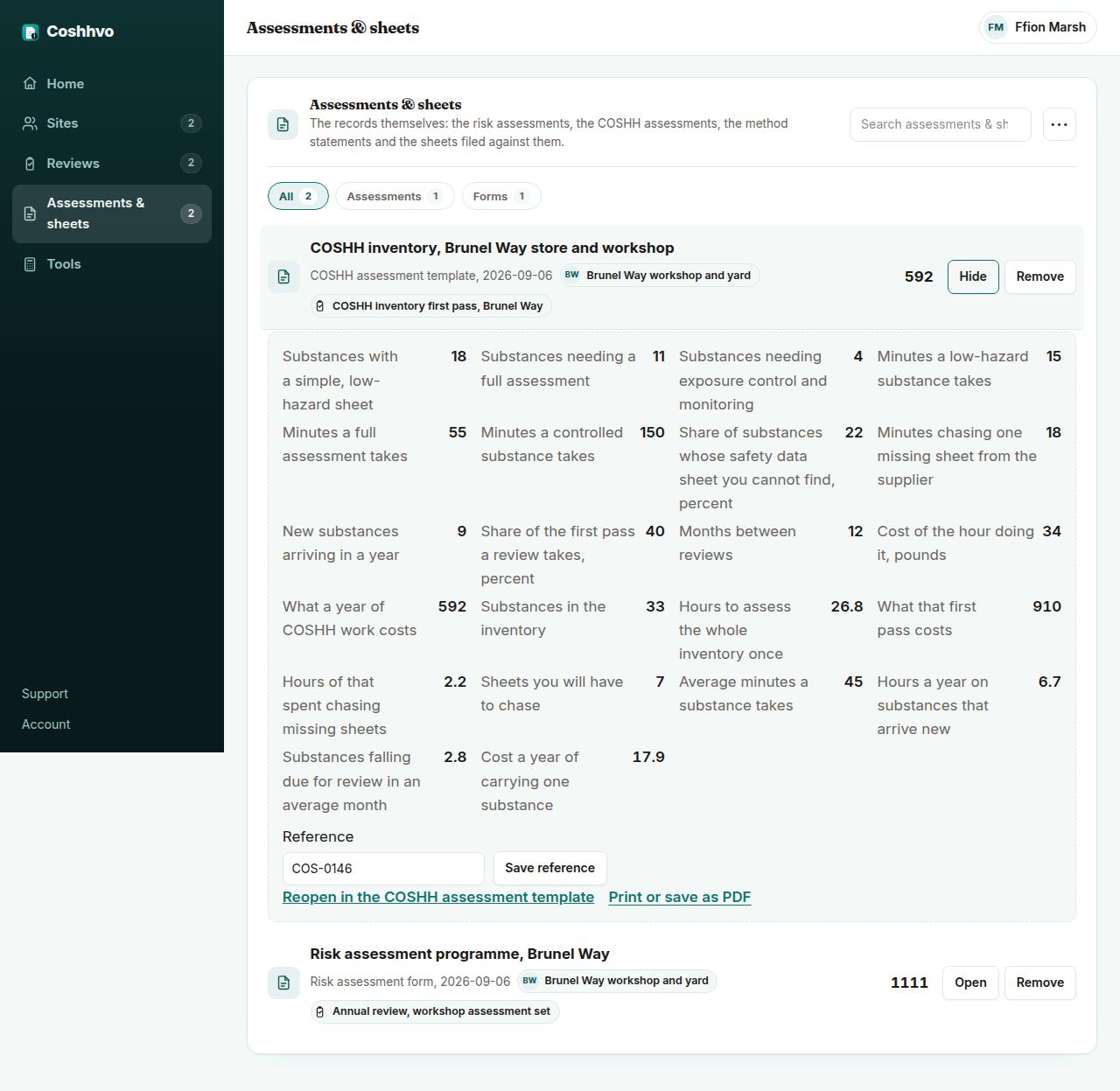
The COSHH assessment worksheet sizes the substance work from what is actually in the store and the workshop: the substances split into the simple ones, the ones needing a full assessment and the ones needing exposure control and monitoring, the minutes each of those takes, the share of substances whose safety data sheet you cannot currently find and the minutes chasing one from a supplier, the new substances that arrive in a year, the review cycle and what share of the first pass a review costs, and what the hour costs you. It returns the hours and the money for the first pass over the whole inventory, how much of that is chasing paper rather than assessing anything, the substances falling due for review in an average month, and what carrying one substance costs a year.
What a safety manager asks before running the COSHH assessment template
Why does it ask how many safety data sheets I cannot find?
Because it is the figure that decides how long the exercise really takes, and it is the one nobody estimates before starting. A COSHH assessment begins with the supplier's sheet; if a fifth of the inventory has no sheet on file, a fifth of the job is emails and phone calls before any assessing happens. Putting that on the same page as the assessing time is what makes the estimate survive contact with the store cupboard.
Does every substance need a full COSHH assessment?
No, and that is why the worksheet splits them three ways. The regulator's own guidance is that the assessment has to be proportionate: many everyday products need little more than reading the label and the sheet and recording the control, while a substance with an exposure limit and engineering controls behind it is a different piece of work. Which of yours is which is a judgement about your own use of them.
Does the worksheet tell me whether my controls are adequate?
No. It sizes and prices the assessing as a piece of work, from your figures. Whether a control is adequate for a particular substance in a particular process is decided by someone competent who has seen the work, against the exposure the substance actually produces there.
Where the constants in this tool come from
HSE, COSHH: What is a COSHH assessment?. Why the worksheet splits substances three ways rather than treating them alike: the regulator's guidance is that assessing is about identifying the hazardous substances, the harm they can do and the steps needed, in proportion to the risk, so a labelled cleaning product and a substance with an exposure limit are not the same piece of work.
Control of Substances Hazardous to Health Regulations 2002, regulation 6 (legislation.gov.uk). The duty the exercise exists to meet: an employer shall not carry on work liable to expose employees to a substance hazardous to health unless a suitable and sufficient assessment of the risk has been made, and shall review it regularly and whenever there is reason to suspect it is no longer valid. That review trigger is why the worksheet asks for a cycle AND for the substances arriving new.
HSE, Working with substances hazardous to health: a brief guide to COSHH (INDG136). The plain-language version of the same duty, and the source of the working assumption behind the tool's default split: most firms have a long tail of everyday products and a short list of substances that need real control, and the cost of the exercise is dominated by the tail's paperwork rather than by the short list's difficulty.